In July 1928, a naturalist named Frederick Gaige collected a male bird in a shaded oak canyon high in the Chisos Mountains, the first confirmed record of that species anywhere in the United States. Nearly a century later, the Colima warbler still nests in this country in exactly one place: that same range of mountains, and nowhere else.
That's not a coincidence of range maps. It's what happens when a forest gets stranded on top of a desert, cut off by elevation the way an actual island is cut off by water.
An Island Made of Elevation
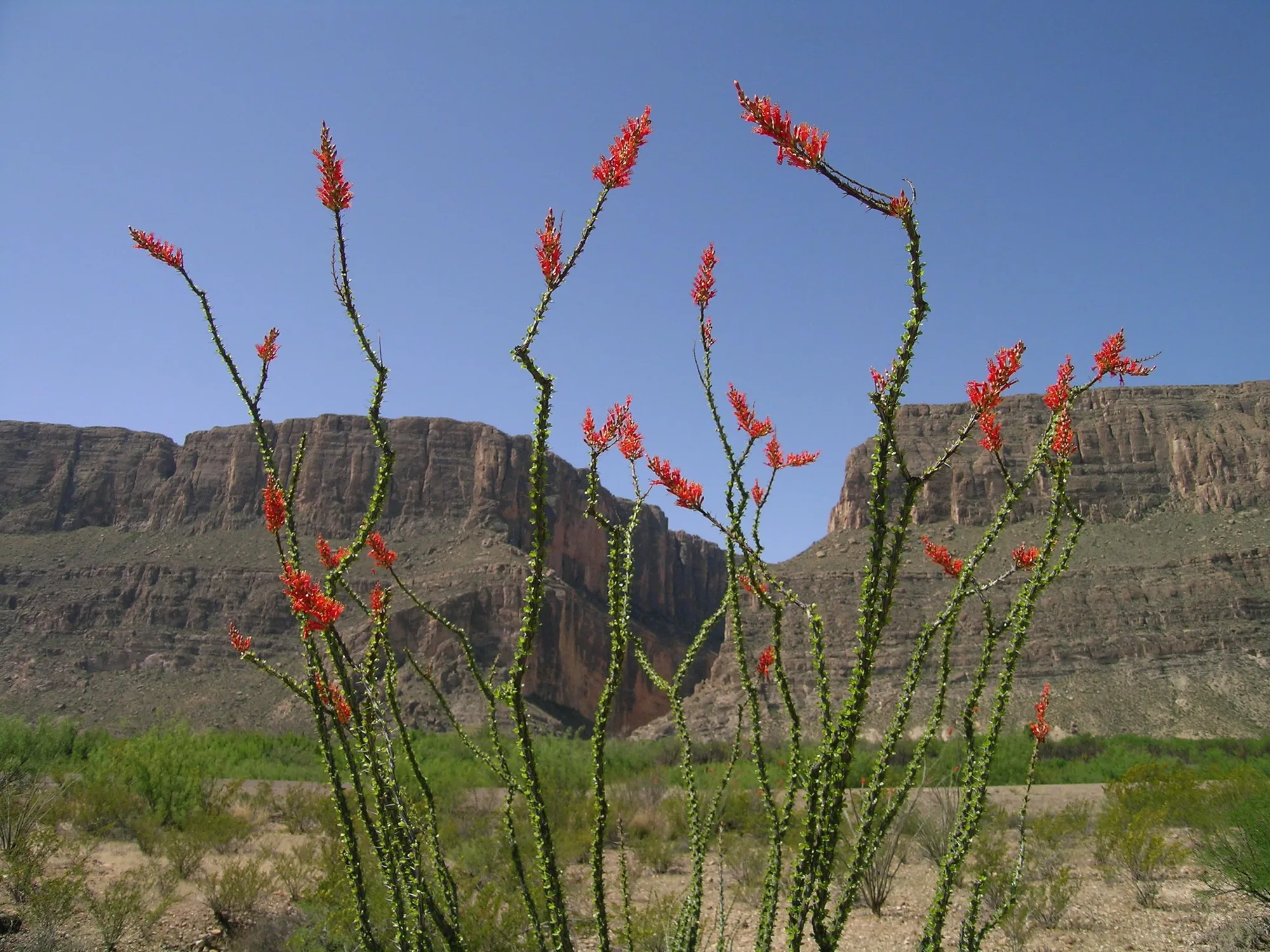
The Chisos Mountains formed volcanically between 38 and 32 million years ago, rising from roughly 1,800 feet along the Rio Grande to 7,832 feet at Emory Peak, the range's highest point and the tallest of four Chisos summits above 7,000 feet. That elevation gain does something the surrounding Chihuahuan Desert can't: it supports oak, maple, and piñon woodland at altitude that has no business existing in a landscape this dry at sea level. The National Park Service describes the Chisos as a forested island in a desert sea, and the description holds up literally. Species that need that cooler, wetter forest habitat are as cut off up here as they would be on an island a hundred miles out in open water, unable to cross the desert in between to reach the next patch of similar habitat.
The Bird That Made the Island Famous
Frederick Gaige's July 1928 specimen, collected in the oak woodland of Boot Canyon, remains the Colima warbler's first confirmed US record, and Boot Canyon is still where nearly all of its known US nesting happens today. The bird nests specifically on north-facing slopes of humid canyons above 6,000 feet, a habitat requirement narrow enough that it rules out almost everywhere in the country except this one range. It's a small, gray-and-yellow bird, easy to overlook, and its US range comes down to a single canyon system inside a single mountain range inside a single national park.
Plan Your Big Bend Visit
Reaching Boot Canyon means a strenuous high-elevation hike, either the Pinnacles Trail or the Laguna Meadows Trail connecting to it. The trip planner can help you time it against the warbler's spring arrival.
Open the Trip PlannerA Narrow Window, Every Spring
Colima warblers winter in Mexico and arrive back in the Chisos in mid-to-late April, breeding through May before departing again by late summer. The National Park Service describes the population as relatively stable, tracked through citizen-science surveys, sometimes involving as many as 35 volunteers, conducted every five years since 1967. Independent birding estimates put the number of individuals returning each spring at roughly a hundred or more, though neither source offers a precise census total, and that imprecision is worth stating plainly rather than dressing up as a harder number than it is. What's certain is narrower and more remarkable than any count: for a few weeks each spring, one specific high-elevation canyon in Texas is the only place in the entire United States where this bird can be reliably found at all.
One Species Among Many, All Depending on the Same Elevation
Big Bend's full species count reflects the same elevation-driven range this bird depends on: more than 1,200 plant species, more than 450 bird species, among the highest counts recorded in the National Park System, and 75 mammal species, including 20 bat species. Among those bats is the endangered Mexican long-nosed bat, found in the US nowhere but here, following the same logic that strands the Colima warbler in one canyon: a species adapted to a narrow band of habitat, with nowhere else in the country offering the same conditions. Big Bend is the largest protected stretch of Chihuahuan Desert habitat in the United States, and the Chisos rising out of the middle of it are the reason that desert alone doesn't tell the whole story.
- Elevation range ~1,800 TO 7,832 FT (EMORY PEAK)
- First US Colima warbler record JULY 1928, BOOT CANYON
- Nesting elevation ABOVE 6,000 FT, NORTH-FACING SLOPES
- Bird species, park-wide 450+
Facts and figures checked against the National Park Service's own pages on the Chisos Mountains, Big Bend's Colima warbler history, and its mammal and animal species counts, supplemented by National Parks Traveler's reporting on the warbler's breeding range and access trails. Population estimates for the Colima warbler's spring return are approximate on both the NPS and independent birding sources consulted, and are presented here as estimates rather than a precise count.
Frederick Gaige's 1928 specimen sits in a museum drawer somewhere now, a single bird collected in a single canyon. The species it came from is still returning to that same canyon every spring, a hundred years later, because the desert around it never gave it anywhere else to go. The island is still exactly as stranded as it was the day he found it.