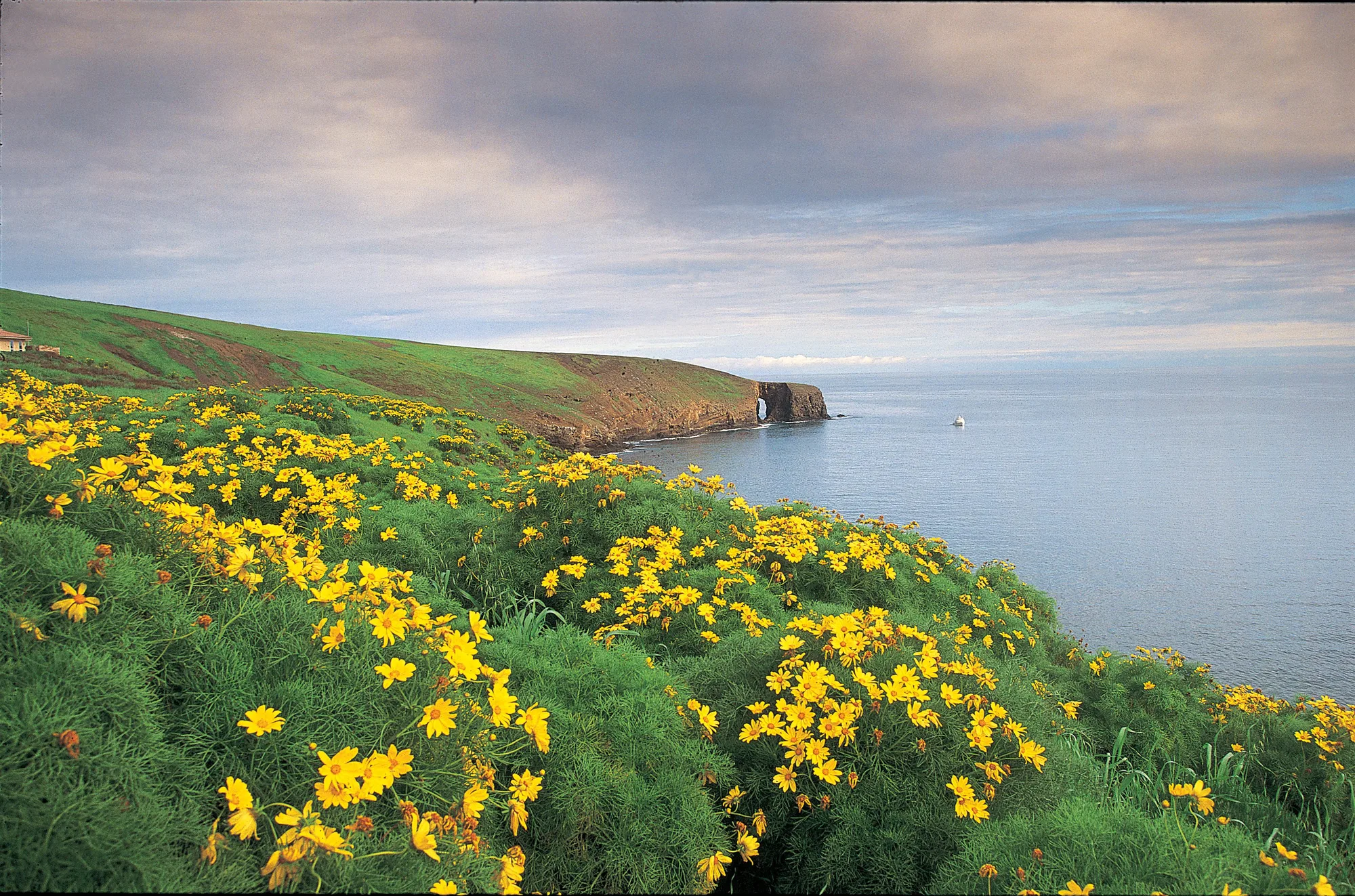
Nothing above the waterline at Channel Islands grows anywhere near this fast. Below it, giant kelp can climb two feet a day, straight up from a hundred feet down.
The World's Largest Marine Algae Grows Like Nothing Else Here
Giant kelp is the largest species of marine algae in the world, and the National Park Service is specific about how fast it moves: rooted at depths approaching 100 feet, it sends fronds toward the surface at up to two feet a day. Gas-filled bladders at the base of each blade keep the growing stalk buoyant and upright as it climbs, the way a series of small balloons might hold up a rope. At the bottom, a root-like holdfast anchors the whole structure to the rock, doing double duty as shelter for juvenile sea stars and urchins before they're big enough to fend for themselves in open water.
Two feet a day is fast enough that a kelp forest isn't really a fixed structure so much as a standing race, blades constantly pushing upward toward light while older growth below gets shaded out and drifts off as food for the reef beneath it. Off Anacapa and the other islands, that race happens practically year-round, building a three-dimensional canopy of brown-gold blades that can run from the seafloor to the surface and back down again with the swell.
- Growth rate UP TO 2 FT PER DAY
- Rooting depth NEARLY 100 FT
- Classification WORLD'S LARGEST MARINE ALGAE
- Buoyancy GAS-FILLED BLADDERS AT EACH BLADE
Watch It Without Getting Wet
Channel Islands Live streams ranger-guided dives through the kelp forest with real-time narration, no wetsuit required.
Open the Trip PlannerEverything Down There Is Renting Space From the Kelp
The National Park Service describes the kelp forests around the Channel Islands as one of the most biologically diverse ecosystems anywhere in the world, home to more than 1,000 species of animals and plants living in and around the canopy. Seals and sea lions hunt through the blades. Fish of every size use the fronds as cover, from small, brightly colored species that never leave the forest to larger predators passing through. Lobsters and spiny sea urchins work the rocky bottom the holdfasts are anchored to, and countless smaller invertebrates and algae fill in every layer in between, from the seafloor up through the mid-water canopy to the surface where the blades finally break into sunlight.
None of that community built the structure it lives in. The kelp did, growing two feet a day toward light it needs for itself, and the 1,000-plus other species simply moved into the forest that resulted, the way birds move into a tree they had no part in growing. Divers and snorkelers can access the kelp forests directly through park concessionaires, tour boats, or private vessels, and for anyone not ready to get in the water, the park's Channel Islands Live program streams ranger-led dives with real-time narration, an actual look at the forest from a boat that never has to leave the dock.
- Species supported 1,000+
- Includes SEALS, SEA LIONS, FISH, LOBSTERS, SEA URCHINS
- Access CONCESSIONAIRES, DIVE BOATS, PRIVATE VESSEL
- No wetsuit needed CHANNEL ISLANDS LIVE, RANGER-NARRATED DIVES
Giant kelp growth rate, rooting depth, and physical structure checked against the National Park Service's official giant kelp page. Species diversity figures, marine life, and access/viewing options checked against the National Park Service's official diving and snorkeling guide for Channel Islands National Park.
Come back to that two-feet-a-day number. It's easy to read past as trivia, but it's the whole reason any of this exists: a stalk of algae racing toward the surface faster than almost any plant on land ever grows, building a forest tall enough to hold a thousand other species by accident, on its way to sunlight it needed for itself. The Channel Islands are usually described by their coastline. Most of the actual forest is underneath it.