
Captains hauling ore and grain across Lake Superior in the late 1800s had to thread a three-and-a-quarter-mile needle between Isle Royale's Passage Island and Blake Point to reach the silver boomtown of Silver Islet, and by 1872 that strait already had a reputation as one of the most dangerous stretches of water on the lake. Ten ships that didn't make it through are still down there today, laid out along the bottom in a very literal record of exactly how dangerous.
A Passage Ships Couldn't Avoid
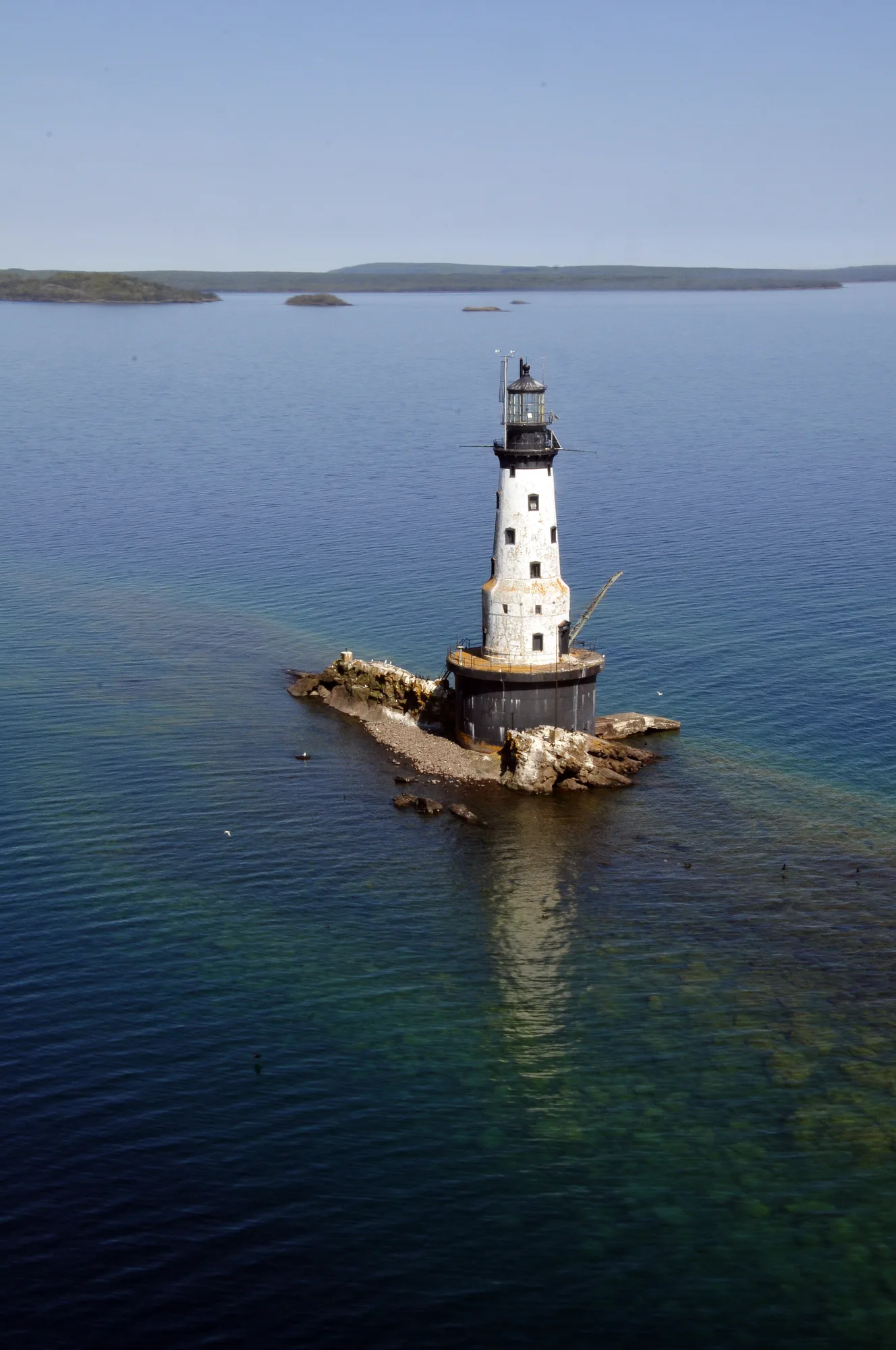
Ships bound for Canada's Silver Islet mine, and later the scheduled freight and passenger routes that grew up around it, had one practical way through: the narrow channel between Passage Island and Blake Point at Isle Royale's northeastern tip. Fog off Lake Superior, submerged rock, and traffic that only grew heavier through the turn of the century made it a place where a small navigational error had almost no room to correct itself.
Ten shipwrecks from that stretch of water are listed today on the National Register of Historic Places, spanning seven decades: the passenger steamer SS Cumberland, lost in 1877, is the oldest; the bulk freighter SS Emperor, lost in 1947, is the most recent. Between them went the SS Algoma, the SS Henry Chisholm, the SS America, the SS Chester A. Congdon, the SS George M. Cox, the SS Glenlyon, the SS Monarch, and the ship this piece is really about, the SS Kamloops.
- Wrecks on the National Register 10
- Strait width 3.25 MILES, PASSAGE ISLAND TO BLAKE POINT
- Hazard recognized by 1872
- Earliest wreck SS CUMBERLAND, 1877
- Most recent wreck SS EMPEROR, 1947
Plan an Isle Royale Trip
Several of these wrecks are accessible to certified divers straight out of Rock Harbor. Build the logistics into a real itinerary.
Open the Trip PlannerFifty Years Under 260 Feet of Water

The Kamloops left Port Colborne, Ontario on December 1, 1927, and ran straight into a severe northeast gale and blizzard on Lake Superior. On December 6, the captain of a nearby steamer, the Quedoc, watched the Kamloops fail to answer danger signals near the rocks off Isle Royale. Nothing more was heard from her. All 22 people aboard, including two stewardesses, Jennet Grafton and Alice Bettridge, were lost.
Isle Royale fishermen found bodies and wreckage washed ashore in May and June of 1928, five months after the storm, enough to confirm what had happened but not enough to find the ship itself. That took until August 21, 1977, when sport divers running a systematic search located the Kamloops more than 260 feet down, resting on her starboard side at the base of an underwater cliff, her smokestack broken off and lying nearby, cargo still sitting in the holds. Human remains are still aboard, including one crew member, lodged beneath a stairway in the engine room, whom the divers who found him nicknamed Old Whitey.
- Departed PORT COLBORNE, ONTARIO, DEC. 1, 1927
- Last contact DEC. 6, 1927, IN A NORTHEAST GALE
- Crew lost 22, NO SURVIVORS
- Wreckage found ashore MAY–JUNE 1928, BY FISHERMEN
- Wreck located AUG. 21, 1977, BY SPORT DIVERS
- Depth 260+ FEET
The strait's hazard history and the list of ten National Register wrecks checked against the National Park Service's official Isle Royale shipwrecks page. The Kamloops's final voyage and the 1928 discovery of bodies and wreckage checked against the National Park Service's own account of the wreck event. The ship's 1977 rediscovery, depth, and current condition, not detailed on NPS's own pages, were checked against published maritime-history sourcing.
The strait between Passage Island and Blake Point still carries boat traffic today, mostly divers now instead of freighters, headed out to the same ten wrecks that gave the passage its reputation in the first place. Lake Superior's cold, fresh water is kind to what it sinks, which is exactly why the Kamloops still looks like a ship and not a ruin, sitting where she has sat since 1927, found for real only in 1977, forty-nine years after the gale that sent her down.