
Dr. John Croghan bought Mammoth Cave and roughly two thousand acres around it in October 1839, paying ten thousand dollars for a Louisville physician's idea of a cure. He believed the cave's constant temperature might halt tuberculosis, and by the winter of 1842 he had moved sixteen patients into stone and wood huts built into the cave itself to find out. Five of them died there. Croghan died seven years later of the same disease he had been trying to treat.
It's a story that reads like a cautionary tale from a distance, and up close it's something more specific: a doctor working from real, observed evidence that pointed him in exactly the wrong direction.
If Meat Doesn't Rot Down Here, Why Would Lungs Fail?
The cave's constant temperature and humidity were the obvious starting point, unchanging year-round in a way no surface climate could match, and Croghan believed that steadiness alone might benefit a disease that seemed to worsen with exposure and exertion. But the detail that actually convinced him, according to the National Park Service's own account, was what he'd observed happening to things that didn't belong down there at all: wood and animal remains left in the cave simply weren't decaying the way they would on the surface. He inferred that whatever was preserving those materials, something about the air itself, might do the same for damaged lung tissue. It was a real observation. The inference from it was wrong.
A Hospital Built Where No Sun Ever Reaches
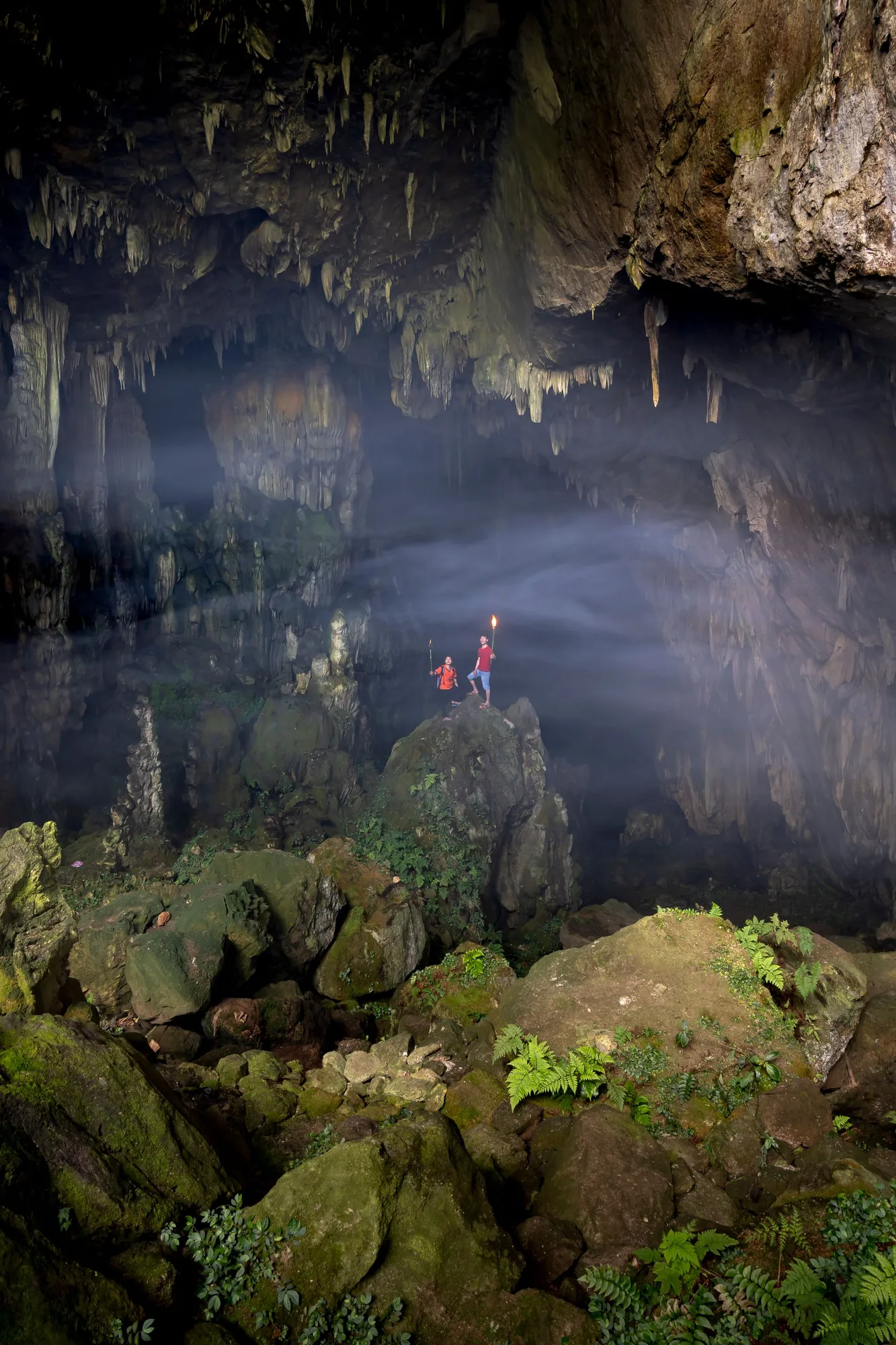
Construction ran through 1842 and 1843: two stone cottages and eight wooden structures, each roughly twelve by eighteen feet, built by enslaved laborers along a main passage now known as Broadway. Sixteen patients moved in starting that winter, drawn by a theory that had real medical credibility at the time and nowhere near enough scrutiny behind it. The experiment ran roughly five months before it was over.
- Structures built 2 STONE, 8 WOOD
- Patients housed 16, WINTER 1842
- Duration ~5 MONTHS
- Deaths inside the cave 5
Plan Your Mammoth Cave Visit
Two of the original stone cottages still stand today along the Broadway passage inside the cave. The trip planner can help you build a tour around them.
Open the Trip PlannerThe Air Wasn't Pure. It Was Trapped.
The huts had no ventilation. Lard-oil lanterns burned constantly for light, and a large fire kept going for cooking and warmth filled the small stone and wood chambers with smoke and ash that had nowhere to go. Combined with the cave's persistent dampness, the effect on patients whose lungs were already damaged by tuberculosis was the opposite of what Croghan had hoped for: irritation and further respiratory decline rather than relief. Five patients died in the cave itself. The rest were eventually moved back to the surface as it became clear the experiment wasn't working. Only one patient is named in the surviving record, a man named H.P. Anderson, notable specifically because he asked for and received permission to leave before the experiment collapsed entirely. No names survive for the five who died.
Croghan Died of Tuberculosis in 1849
John Croghan died on January 11, 1849, of tuberculosis, the same disease he had tried to treat inside his own cave. The two stone cottages from the experiment still stand today along the Broadway passage, visible on tours that pass through that section, a quiet, physical remnant of a theory that failed the people who trusted it. The National Park Service's own account doesn't end the story purely on that irony, though: it credits the episode, failed as it was, with adding real information to what doctors of the era understood about tuberculosis, a small, costly contribution to a body of knowledge that eventually led somewhere better than a cave.
Facts and figures checked against the National Park Service's "Tuberculosis at Mammoth Cave" article, which is the primary source for the hut construction, patient count, deaths, H.P. Anderson's documented case, and Croghan's own death from tuberculosis. Croghan's biography, purchase date, and acreage cross-checked against secondary sources including the Kleber Encyclopedia of Louisville. No names survive in any source checked for the five patients who died in the cave; none are invented here.
Two stone huts still sit along Broadway, empty, in a passage that never sees daylight. They were built on a theory that made sense from where Croghan stood, watching wood and bone hold their shape year after year in air that never seemed to change. The lungs of sixteen people trying to survive tuberculosis needed something the cave never actually had to offer. Seven years later, neither did his.