
Thurmond, West Virginia is still, on paper, an incorporated town, with a mayor and a town government and a spot on the map. As of the 2020 census, five people lived there. In 1930, at the height of the coal boom that built it, 462 did. Nothing burned Thurmond down and nothing forced anyone out. The trains that built the town simply stopped needing what Thurmond had to offer, and almost everyone eventually followed the work somewhere else.
New River Gorge National Park protects whitewater and sandstone cliffs, but a good third of what's actually inside its boundary is this: the standing, decaying, occasionally restored skeleton of an entire coal economy that boomed for about seventy years and then, within a decade, mostly stopped.
Thurmond
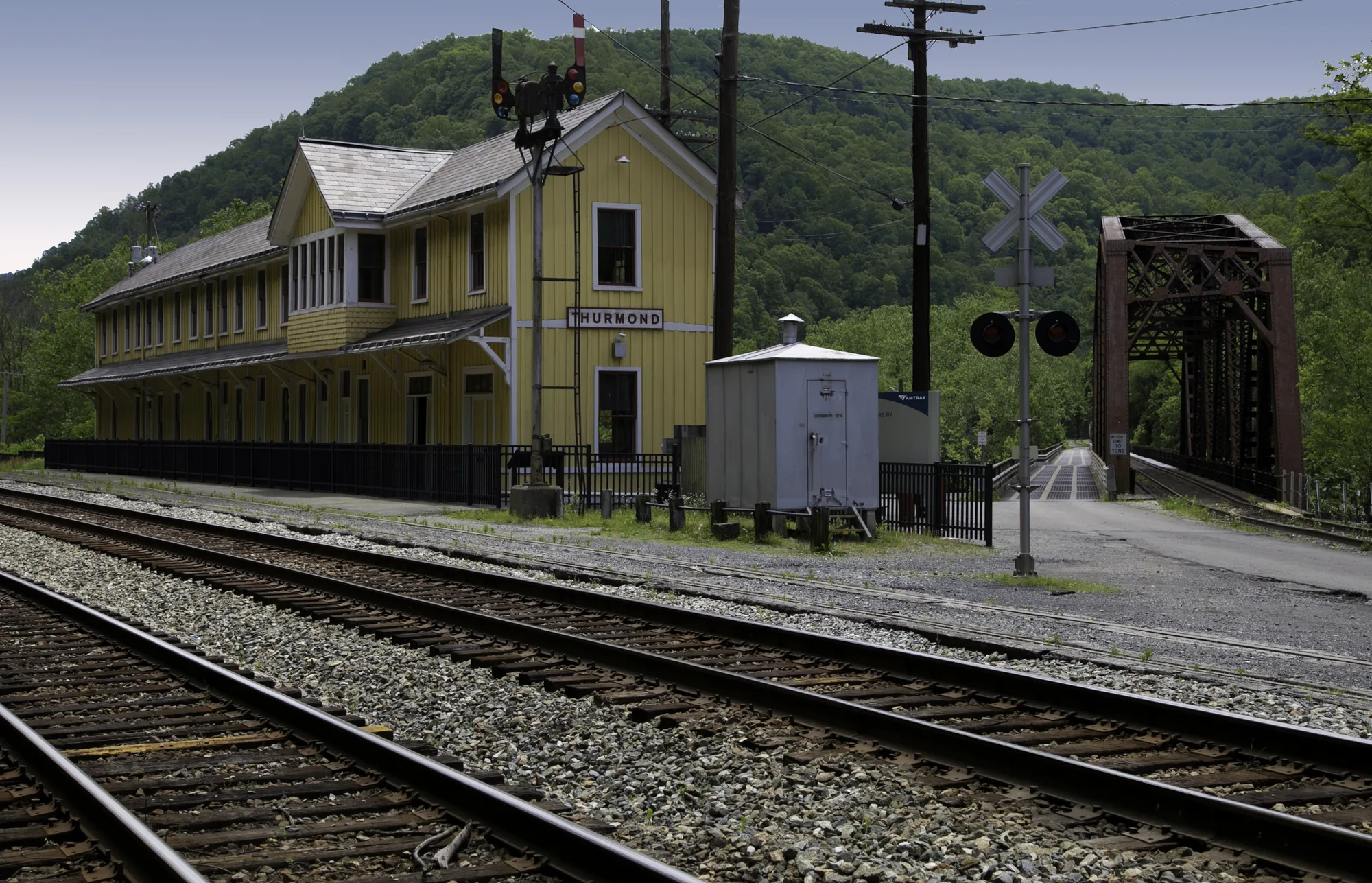
Thurmond grew up because coal from dozens of surrounding mines had to get out of the gorge somehow, and the C&O Railway's line along the New River was that route. The depot, built in 1888, became one of the busiest coal-shipping points on the entire C&O system. The town that formed around it had banks, a bakery, restaurants, and, for a while, a reputation as one of the wealthier small towns in the state, all of it dependent on one industry moving through one narrow gorge.
Thurmond's historic district was added to the National Register of Historic Places on January 27, 1984. The old depot still stands. It's a National Park Service visitor center now, staffed seasonally, sitting across the tracks from a town that, on a quiet weekday, can feel emptier than the parking lot in front of it.
Ballyhack and the Dun Glen Hotel
Thurmond's own town leadership kept it dry and relatively orderly, no saloons, no theaters, a reputation the town's boosters were proud of. That reputation depended entirely on Ballyhack existing just across the New River, where the saloons, gambling, and the rest of what a railroad boomtown's workers wanted on a Friday night were free to operate outside Thurmond's town limits.
The Dun Glen Hotel, on the Thurmond side, is where the legend everyone repeats about this town comes from: according to Ripley's Believe It or Not, a single poker game ran continuously inside the Dun Glen for fourteen years. Nobody claims the same players sat there the whole time. The game itself, by the legend, never stopped.
- Depot built 1888
- Peak population (1930) 462
- Population (2020 census) 5
- Historic district listed JAN 27, 1984
Walk Both Ghost Towns in One Day
Thurmond's depot and the Nuttallburg trail sit on opposite sides of the gorge. The trip planner builds the drive between them.
Open the Trip PlannerNuttallburg
John Nuttall opened the mine at Nuttallburg in 1870, one of the first commercial coal operations in the gorge. It ran as an independent operation for decades before Henry Ford's Fordson Coal Company leased the mine and the surrounding town in the 1920s, drawn by New River coal's low sulfur content and high heat value, ideal for the coking process Ford's automobile plants needed. Ford's company built a mile-and-a-half-long conveyor headhouse down the mountainside to move coal directly from the mine to rail cars on the river below, a piece of engineering still visible on the site today. Ford sold the operation in 1928.
Mining at Nuttallburg continued under other owners until it finally ceased in 1958. The National Park Service acquired the site in 1998 and spent over a decade stabilizing what was left: the conveyor structure, the coal tipple, a scatter of foundations. Stabilization work finished around 2011, and Nuttallburg reopened to the public as a hike-through historic site rather than a functioning ruin left to collapse.
Population: Five
The C&O Railway converted from steam to diesel locomotives through the 1950s, the same decade Nuttallburg's mine shut down for good. Diesel engines didn't need coal, and coal was the only thing this stretch of the New River Gorge had ever really sold. Thurmond's rail traffic and the jobs tied to it shrank fast, and the people who could leave for work elsewhere mostly did.
Thurmond never incorporated its way out of existence. It's still a real town, with a real government, on the census rolls at five residents as of 2020. The depot that once handled some of the busiest coal traffic on the entire C&O line now hands out trail maps.
Facts and figures checked against NPS.gov's Thurmond and Nuttallburg historic site pages and U.S. Census Bureau population records for Thurmond, WV. The Dun Glen Hotel's fourteen-year poker game is a widely repeated local legend, attributed to Ripley's Believe It or Not, and is presented here as legend rather than a verified historical record.
Thurmond still has a mayor. It still has a town government, a spot on the census, a real zip code. It has five people to go with all of that, in a depot building that once moved more coal than almost any stop on the line.