The U.S. Geological Survey has a page whose entire job is talking people out of a specific idea: that Yellowstone's supervolcano is "overdue" to erupt. "Overdue," the agency says, flatly, "can apply to library books, bills, and oil changes, but it does not apply to Yellowstone." The last caldera-forming eruption was 640,000 years ago. USGS puts the odds of another one at exceedingly small over the next several thousand years. The internet has decided otherwise anyway.
That gap, between what people assume about this park and what's actually documented, shows up again and again here. Old Faithful isn't on a 90-minute schedule. The 1988 fires weren't a management failure so much as a policy nobody had stress-tested. The wolves didn't just come back, they'd been gone, on purpose, for almost 70 years. Yellowstone rewards checking your assumptions almost as much as it rewards the scenery.
Not Actually on the Hour
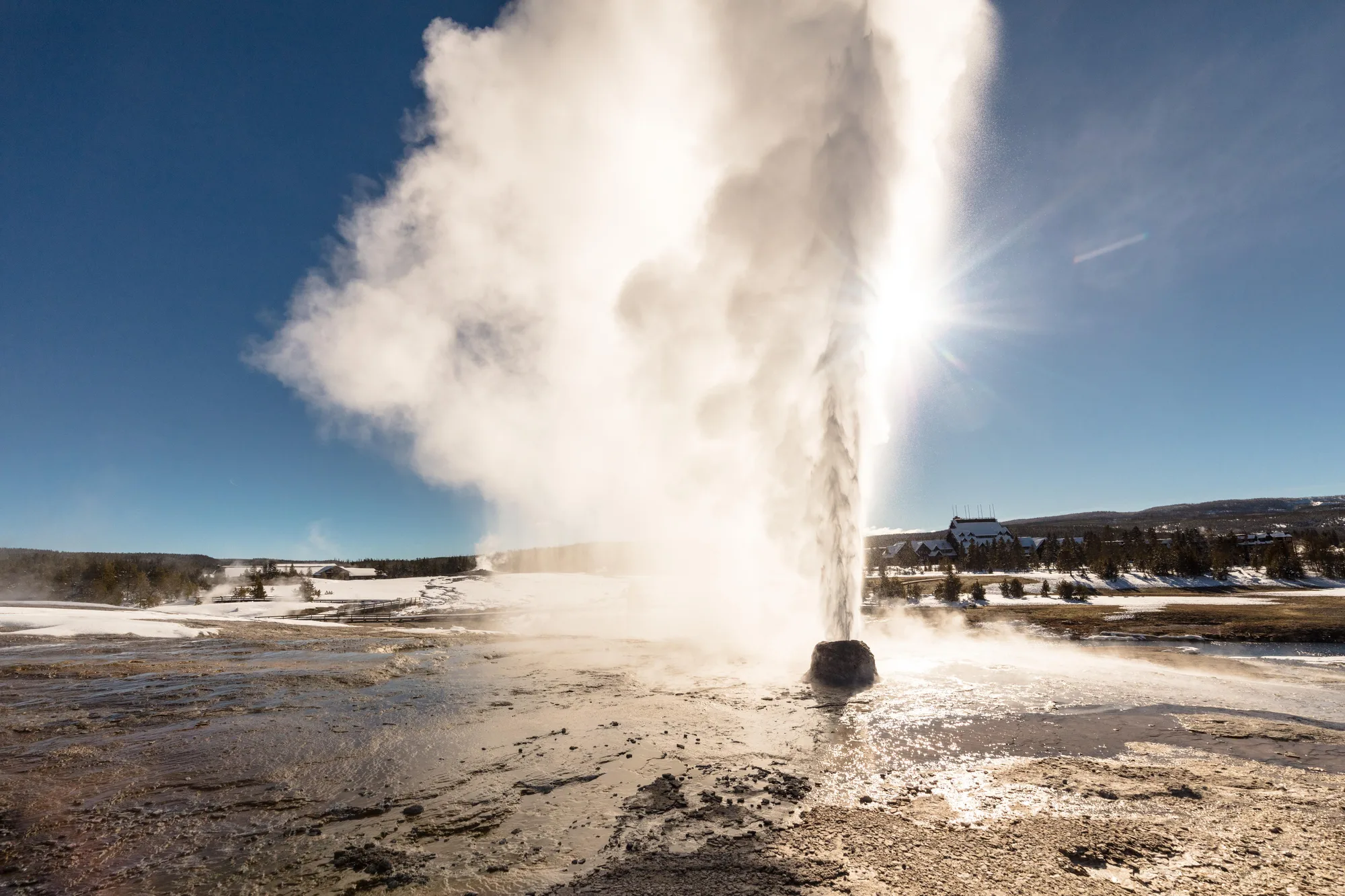
Old Faithful erupts anywhere from 35 to 120 minutes apart, and the 92-minute average is where the "roughly every 90 minutes" reputation comes from, not a fixed interval. Rangers predict the next eruption using the length and height of the one that just happened, and they get it right, within a ten-minute window, about 90 percent of the time. When it goes, it lasts a minute and a half to five minutes and throws water 90 to 184 feet in the air.
The interval itself has changed over time, and not randomly. Following the 1959 Hebgen Lake earthquake, a magnitude 7.3 that struck just outside the park, the gap between eruptions permanently lengthened, and it's lengthened further after other regional quakes since. The geyser isn't a machine running on a fixed cycle. It's a plumbing system, and earthquakes rearrange plumbing.
- Interval range 35–120 MIN, AVG 92
- Prediction accuracy ~90% WITHIN ±10 MIN
- Eruption height 90–184 FT
Sold With Paintings, Not Arguments
Ferdinand Hayden led a government survey expedition into the Yellowstone region in 1871, and when he got back east, he didn't just file a report. He got an article into Scribner's Monthly illustrated with Thomas Moran's paintings, and he lobbied Congress directly using William Henry Jackson's photographs from the same trip. Painted color and photographic proof did what a written survey alone hadn't managed. On March 1, 1872, Congress passed the act setting the land aside as, in its own words, "a public park or pleasuring-ground for the benefit and enjoyment of the people."
Yellowstone is usually called the world's first national park, and with one honest asterisk: California had already set aside Yosemite Valley as state parkland in 1864. What Yellowstone actually was, first, was the first land protected by the federal government specifically as a national park, a distinction that matters because it's the one that created the model, a federally managed park system, that the rest of the world eventually copied.
Turn This Route Into a Real Plan
Pick your dates and your crew: the AI trip planner builds the day-by-day for Yellowstone, geyser basins and wildlife-viewing windows included.
Open the Trip PlannerThe Volcano That Isn't Due
The Yellowstone Caldera is roughly 30 by 45 miles, a depression left behind when the ground collapsed after a massive eruption emptied the magma chamber below it. That eruption was 640,000 years ago, the youngest of three caldera-forming eruptions here going back 2.1 million years. Everything that makes the park's geothermal features work, the geysers, the hot springs, Mammoth's travertine terraces, comes from that same heat source, still sitting closer to the surface here than almost anywhere else on the continent.
None of that makes another eruption imminent. USGS monitors the caldera continuously and states plainly that the odds of a caldera-forming eruption happening again are exceedingly small over the next several thousand years. The ground here rises and falls a little from year to year as the magma chamber shifts, which is normal, monitored, and not a warning sign. The volcano isn't sleeping through an alarm it missed. It's just running on a timescale that doesn't match a news cycle.
- Size ~30 × 45 MILES
- Last major eruption 640,000 YEARS AGO
- Eruption risk (USGS) EXCEEDINGLY SMALL, NEXT FEW MILLENNIA
The Summer It Burned
From 1972 to 1987, Yellowstone let naturally caused fires burn under a policy built on real historical evidence: left alone, most of them went out on their own after burning an acre or less. The wet spring of 1988 gave managers no reason to expect anything different, so when lightning started 18 fires that summer, they let them burn. Then the drought that followed was severe enough that by mid-July, the fires had grown from a combined one acre to seventeen thousand. On July 15, the park suspended the natural-fire policy. By July 21, every fire was being actively fought.
It didn't matter much at first. About 800,000 acres burned inside the park, 36 percent of it, plus another 500,000 acres on adjacent land. Roughly 10,000 firefighters worked the lines, and the federal government spent more than 120 million dollars trying to stop fires that, in the end, weather stopped instead: a quarter inch of snow fell on September 11 and finally halted the advance that the largest firefighting operation in the country's history hadn't been able to. The forest that's grown back since is doing what lodgepole pine forests here have always done after fire. It just happened at a scale nobody who'd watched this ecosystem for sixteen years had planned for.
Gone on Purpose, Back on Purpose
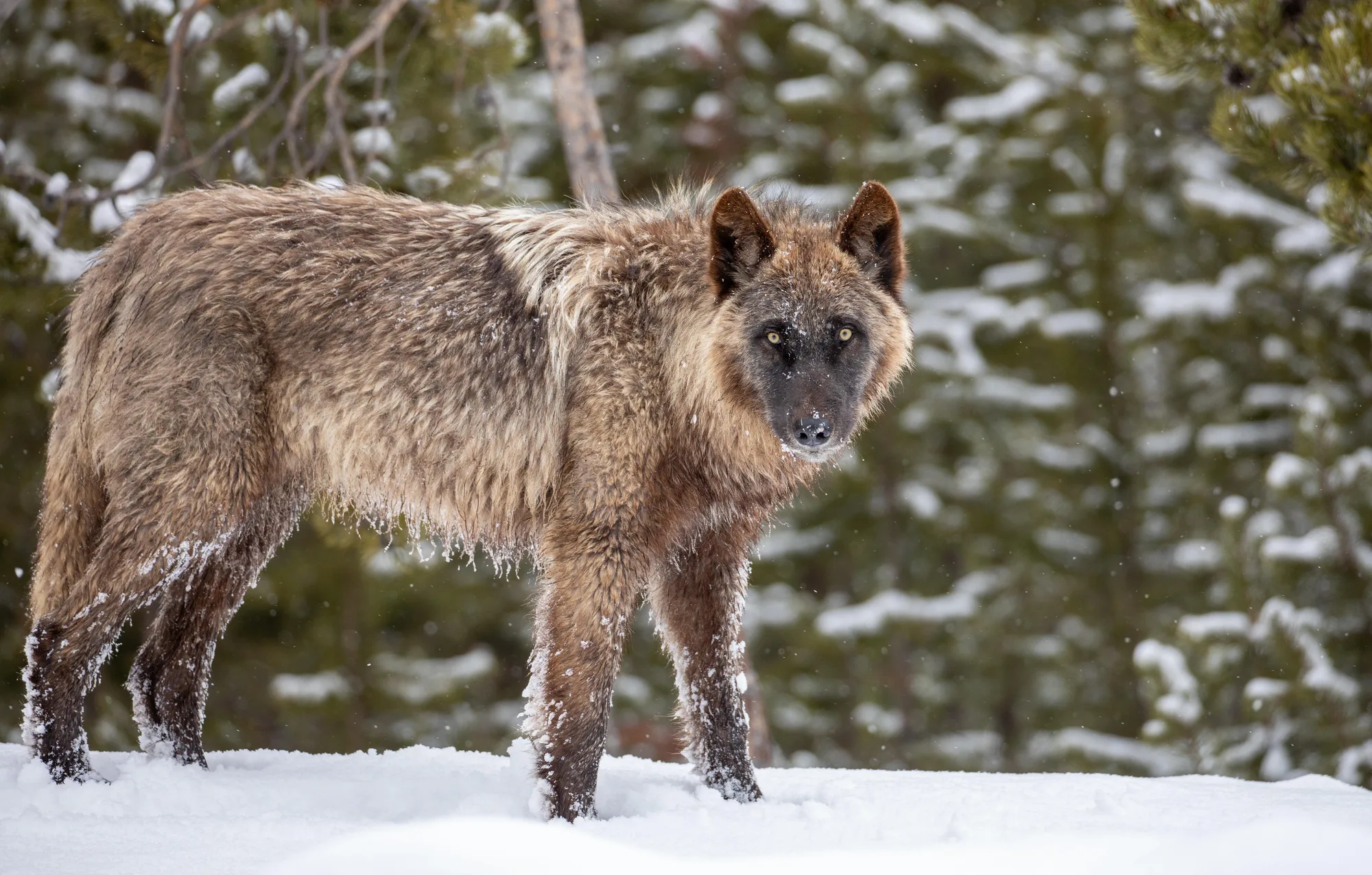
Predator control programs killed off Yellowstone's wolves through the late 1800s and early 1900s, mostly to protect livestock on the land settlers were working around the park. The last known pack was killed in 1926. For nearly seventy years, Yellowstone had elk, and no wolves to hunt them.
In 1995 and 1996, wildlife managers relocated 31 gray wolves from western Canada into the park, and added 10 more from northwestern Montana in 1997, 41 wolves total, deliberately returning a predator the same government had deliberately removed two generations earlier. Researchers have studied the ecosystem's response ever since, elk behavior, vegetation along streams, and the results are real but genuinely debated in the scientific literature, more complicated than the version of the story that went viral online. What's not debated is the basic fact underneath it: an apex predator was gone from this park for seven decades because people decided to remove it, and it's back because people decided to put it back.
Check the Assumption, Not Just the Map
The predicted-eruption board near Old Faithful updates after every eruption using the same duration-based math described above, so check it fresh rather than trusting a number from an hour ago. USGS's Yellowstone Volcano Observatory publishes its ground-deformation data publicly, worth a look if the caldera section above left you wanting the actual numbers instead of just "exceedingly small." And if the wolves are the draw, set the expectation now: the realistic sighting is a shape through a spotting scope in Lamar Valley at dawn, not a roadside encounter, which is why binoculars matter more here than a zoom lens.