The logs get the attention here, whole trees turned to stone. But the rock underneath them is quietly rewriting what people picture when they hear the word "Triassic."
This Ground Predates the Age of Dinosaurs
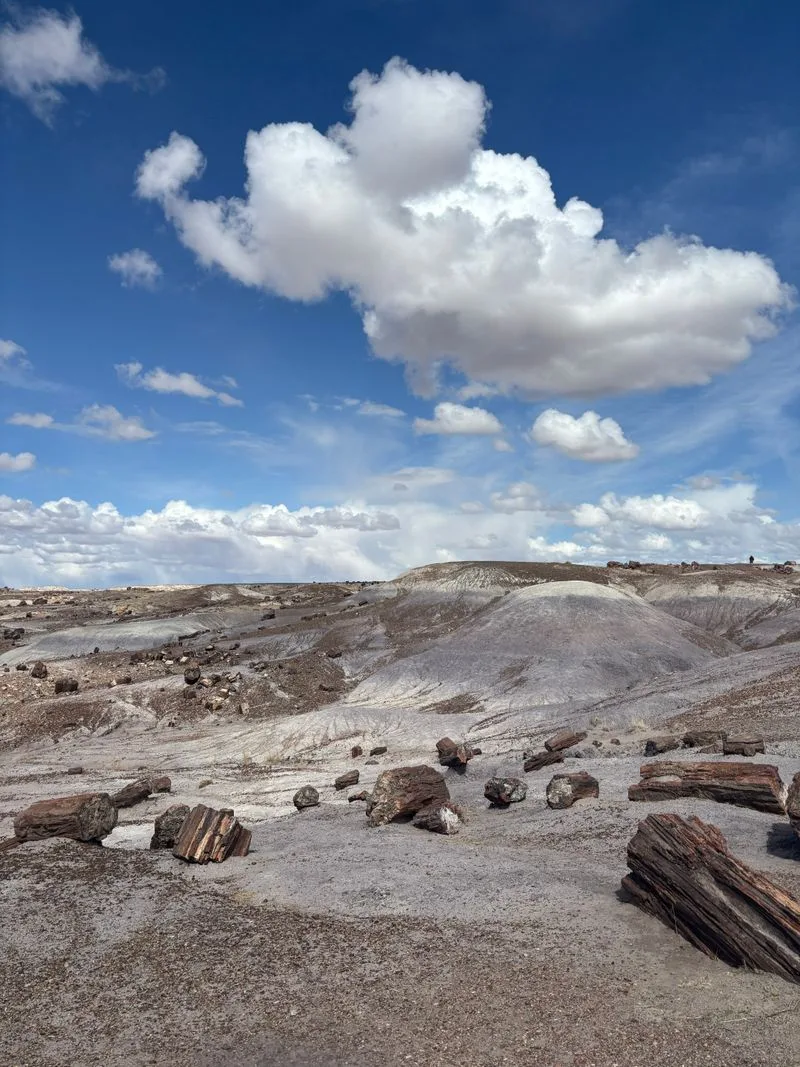
The rock that holds Petrified Forest's fossils, the Chinle Formation, dates to the Late Triassic, roughly 223 to 208 million years ago, according to the National Park Service's own geologic survey of the park. That places it near the dawn of the dinosaurs, a period before dinosaurs had become the dominant land animals most people picture when they hear the word. Instead, the fossil record here shows dinosaurs as bit players in an ecosystem run by other, stranger animals entirely.
One of the park's best-known dinosaur fossils is a partial skeleton nicknamed Gertie, found in the 1980s and formally named Chindesaurus. It was once promoted as a candidate for the world's oldest known dinosaur, a claim that later research has made less certain, and the park's own materials now frame it more cautiously as one of the earliest dinosaurs known from North America rather than a confirmed record-holder. Coelophysis, a small, fast-moving predator, is the other dinosaur genus documented from the formation. Both were modest in size, nothing like the animals that would come to dominate later in the Mesozoic.
Plan Your Petrified Forest Visit
The Rainbow Forest Museum and Crystal Forest area hold some of the park's best fossil and petrified-wood viewing.
Open the Trip PlannerThe Animals That Actually Ran This Ecosystem
The bulk of the large animals documented in the Chinle Formation aren't dinosaurs at all. They're pseudosuchians, a group more closely related to modern crocodiles, and they came in a striking range of forms. Aetosaurs like Desmatosuchus and Paratypothorax were armored, plant-eating reptiles covered in bony plates. Revueltosaurus is a genuinely good story on its own: for years it was classified as a dinosaur based on its teeth alone, until more complete skeletal finds around 2004 revealed it was actually a pseudosuchian wearing dinosaur-like teeth, a correction that reshaped how paleontologists read Triassic tooth fossils generally.
The rest of the neighborhood was just as strange. Placerias, a large plant-eating synapsid distantly related to the lineage that led to mammals, grazed alongside metoposaur amphibians like Koskinonodon, flat-skulled animals built like something between a salamander and a crocodile. A crocodylomorph called Hesperosuchus rounds out the cast. None of them survived past the Triassic, and almost none of them get the name recognition dinosaurs do, but for tens of millions of years, they were the ones running the show.
- Age ~223-208 MILLION YEARS (LATE TRIASSIC)
- Named dinosaurs documented CHINDESAURUS ("GERTIE"), COELOPHYSIS
- Dominant large animals PSEUDOSUCHIANS (CROCODILE RELATIVES)
- Notable reclassification REVUELTOSAURUS, DINOSAUR → PSEUDOSUCHIAN (2004)
The Chinle Formation's age and the named species discussed here checked against the National Park Service's Geodiversity Atlas entry for Petrified Forest and the park's own paleontology pages covering its dinosaur-line ("ornithodiran") and pseudosuchian fossils. Chindesaurus's status as a candidate for the world's oldest dinosaur is treated here as a contested, likely outdated claim rather than a settled fact, per the park's own more cautious current framing. No specific named phytosaur genus is claimed in this piece, since a specific species could not be confirmed against a primary source.
The petrified logs out on the Crystal Forest trail are what draw people here, and they earn it, whole trunks turned to banded stone. But under those logs is a fuller picture: a world where the animals that would eventually take over the planet were still minor characters, outnumbered by armored crocodile cousins and flat-headed amphibians that never made it into a single natural history museum's gift shop. The dinosaurs won, eventually. Here, the fossil record catches them before anyone knew that was going to happen.