
Long before Saguaro became a national park, and long before there was a fence line or a visitor center to mark where its boundary sat, Tohono O'odham families were already walking out into these same stands of cactus every June, carrying poles cut from the saguaro's own dead ribs, to bring down fruit that ripens for about two weeks a year and nowhere else on the calendar.
The harvest is called bahidaj, and for the Tohono O'odham it marks the start of a new year, not in January but in the heat just before the summer monsoon, when a plant most visitors only photograph becomes something closer to a calendar, a pantry, and a prayer all at once.
A Fruit With a Two-Week Window
A saguaro needs to be around thirty years old before it flowers and fruits reliably, which already makes bahidaj a harvest built on patience most crops never demand. The fruit itself, called bahidaj in the O'odham language, ripens in late May into June, splitting open to reveal a deep red pulp packed with tiny black seeds, sweet enough that early Spanish visitors compared it to fig. Families historically moved to harvest camps for the season to work the stands efficiently before the fruit spoiled or the birds and other animals took what was left, since the entire crop across an enormous cactus, dozens of fruits per plant, all ripens within roughly the same two-week stretch.
A Tool Made From the Plant Itself
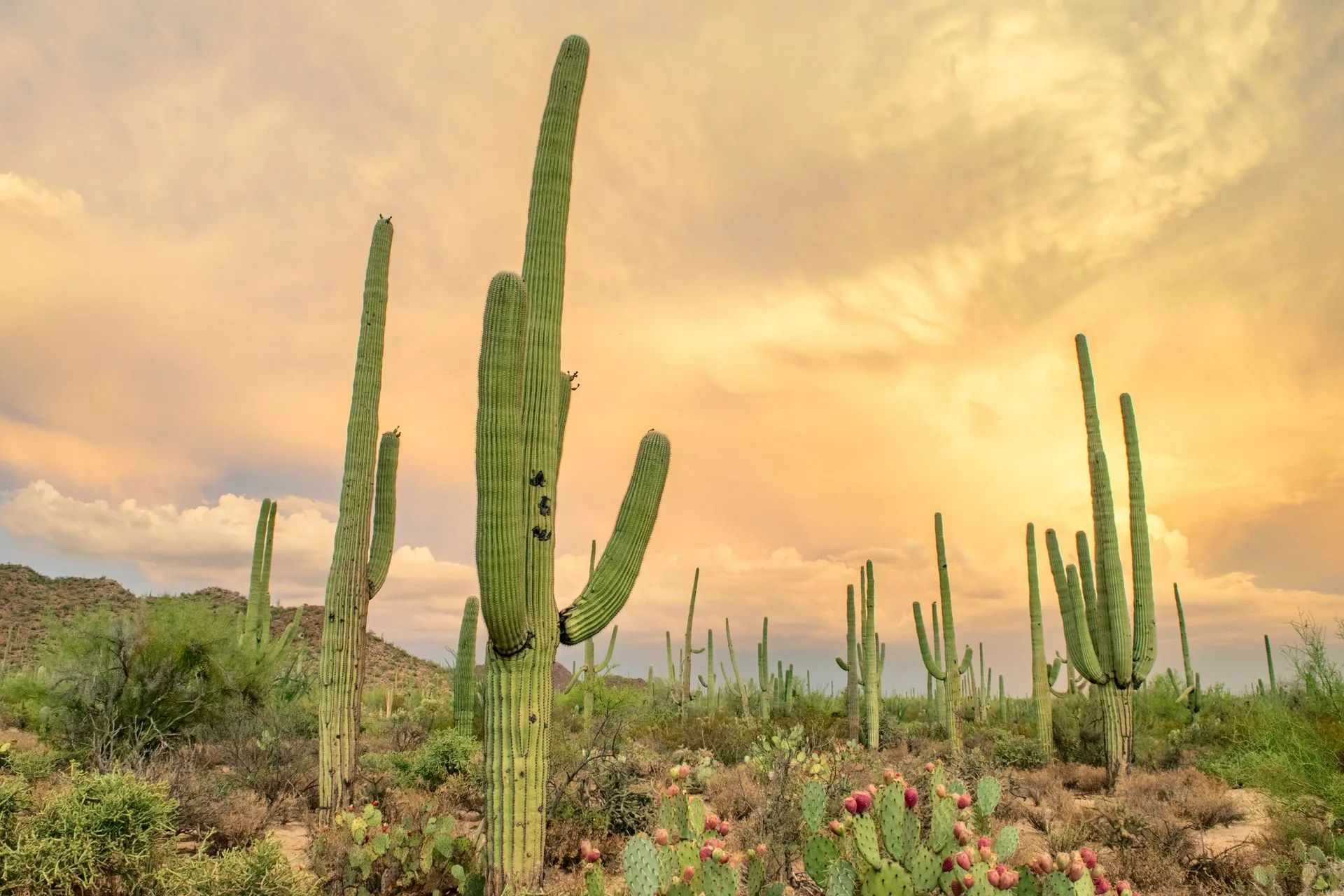
Saguaro fruit sits at the very top of a plant that can stand over forty feet tall, well out of reach of anyone on the ground, so harvesters use a tool called a kuibit, a pole roughly ten feet long built from the saguaro's own woody ribs, the same internal skeleton that stays standing long after the soft flesh around it has died and rotted away. Two shorter ribs are typically lashed near the tip at an angle, forming a small hook or crossbar used to knock ripe fruit loose so it drops to a cloth or basket spread below. The O'odham refer to saguaros as ha꞉ṣañ, and describe them not simply as a resource but as family, a framing that shapes how the harvest itself is carried out: carefully, by hand, plant by plant, using a tool the desert already provided.
Plan Your Saguaro Visit
Late spring is when saguaros bloom and begin fruiting. The trip planner can help you time a visit around the season.
Open the Trip PlannerA Wine, and a Prayer for Rain
Bahidaj pulp gets boiled down into a thick syrup, and a portion of that syrup is fermented into saguaro wine, central to a ceremony called Nawait I'i, a communal rain prayer traditionally timed to precede the arrival of the summer monsoon. The logic is direct rather than symbolic: the harvest happens in the driest, hottest stretch of the year, right before the rains that the entire desert, people, saguaros, and everything that depends on them, needs to survive the year ahead. Elder Juanita Ahil was among those who advocated in the 1960s for keeping these traditions active as younger generations moved away from the reservation and the annual harvest camps thinned out. Tribal members including Tanisha Tucker Lohse, Maria Francisco, Josephine Ramon, Amy Juan, Francine Larson Segundo, and Helen Ramon have carried that work forward since, and the practice has seen a documented resurgence of interest in recent years among younger O'odham reconnecting with a season their grandparents once ran as a matter of course.
A Formal Agreement for an Old Relationship
The Tohono O'odham's relationship to this land goes back long before Saguaro National Park existed in any form, and a federal rule adopted in 2016 formally recognized traditional plant-gathering rights, including the saguaro harvest, on National Park Service land. Then-Superintendent Leah McGinnis described the tribe's connection to the park's saguaros as a relationship stretching back more than fifty years of collaborative management even before that rule existed, on top of a much longer history of the O'odham using this land that predates the park by generations. Silas Garcia, a tribal member involved in the harvest, put it plainly: the saguaro connects "to who I am, to where our stories talk about where we come from as a people."
- Harvest window LATE MAY-MID JUNE
- Saguaro age to fruit ~30 YRS
- Traditional pole (kuibit) ~10 FT
- Federal gathering rule 2016
Facts and figures checked against the National Park Service's published materials on Tohono O'odham traditional gathering agreements and the 2016 federal rule (36 CFR § 2.6), archived NPS interviews and statements on the saguaro harvest partnership, and public reporting on the Nawait I'i ceremony and bahidaj harvest season.
The saguaros along the Cactus Forest Loop look, to most visitors driving past in June, exactly like they do every other month, tall, spined, unremarkable in their patience. What's different for two weeks a year is who's standing underneath them with a ten-foot pole, working a harvest that was already old when the first park boundary sign went up, and that the paperwork now formally protects instead of merely permitting.