
This forest survived not because anyone set out to save it, but because a lumber company took one look at the swamp and, after a decade of trying, gave up.
The Land Was Too Hard to Log Profitably
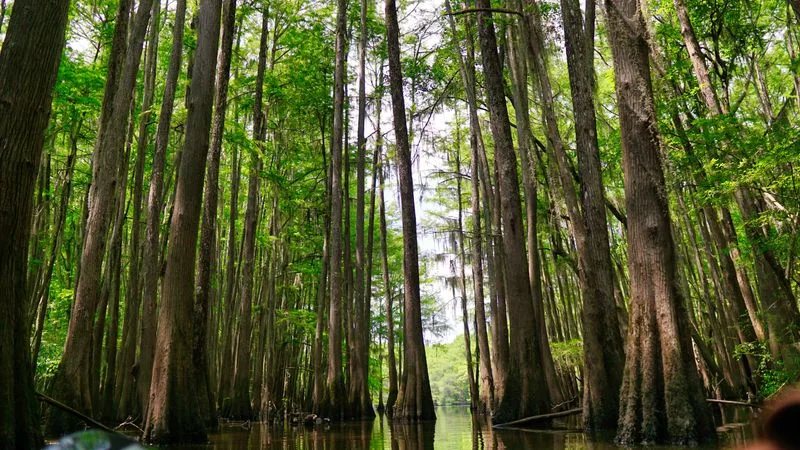
The Santee River Cypress Lumber Company, under Francis Beidler, had acquired the tract that's now Congaree by 1905, betting on the old-growth cypress and hardwood standing in the floodplain. The bet didn't pay off the way a normal timber operation would. The ground flooded routinely, the heat and mosquito-borne malaria made the work brutal on crews, and much of the cypress was too dense to float downriver the way loggers usually moved timber out of a swamp. Logging here was, by later accounts, hellishly difficult and basically unprofitable.
By around 1915, the operation had largely been abandoned, leaving more than 10,000 acres of the floodplain essentially untouched. Beidler didn't sell the land off afterward. Instead, he held it in what amounted to a long-term timber reserve, betting that old-growth trees would only become more valuable as they grew scarcer elsewhere. That gamble, made for purely financial reasons, is the reason there was still an old-growth forest left to fight over half a century later.
Plan Your Congaree Visit
The Boardwalk Loop Trail is the easiest way to walk through the same old-growth canopy this history saved.
Open the Trip PlannerA Second Logging Attempt Triggered the Campaign to Save It
The reserve held for decades, until Beidler's heirs resumed logging operations in 1969, threatening to finish what the original company had abandoned. That decision triggered a conservation campaign that had actually been building since 1961, when newspaperman Harry Hampton founded the Beidler Forest Preservation Association specifically to protect the tract. In 1972, a broader group calling itself the Congaree Swamp National Preserve Association formed under Jim Elder, a schoolteacher, and partnered with the Sierra Club and other conservation organizations to lobby Congress directly.
The campaign succeeded. President Gerald Ford signed legislation establishing Congaree Swamp National Monument on October 18, 1976, protecting the old growth that Beidler's failed logging operation had inadvertently preserved for seven decades. The site was redesignated Congaree National Park on November 10, 2003, elevating it to full national park status and the name it carries today.
- Santee River Cypress Lumber Co. acquires tract BY 1905
- Logging largely abandoned ~1915
- Beidler heirs resume logging, sparking campaign 1969
- Congaree Swamp National Monument established OCT 18, 1976
- Redesignated Congaree National Park NOV 10, 2003
The Santee River Cypress Lumber Company's acquisition, the abandonment of logging around 1915, and the conditions that made the operation unprofitable checked against National Parks Traveler's history reporting on Congaree and the Beidler tract. The 1969 resumption of logging, the roles of Harry Hampton, the Beidler Forest Preservation Association, and the Congaree Swamp National Preserve Association, and the October 18, 1976 monument and November 10, 2003 national park redesignation dates are sourced primarily from the Wikipedia entry for Congaree National Park; these dates are consistent with the park's own stated history but were not independently re-verified against a second primary NPS source at time of writing.
Most of the old-growth forest that once covered the American Southeast is gone, cut for lumber before anyone thought to argue otherwise. Congaree's survived on a technicality: a swamp too miserable to log profitably the first time, held onto by a company that never quite let it go, and then fought for by name in Congress the second time someone tried. The trees standing over the boardwalk today are less a preserved wilderness than a business decision that happened to work out for the forest.