Somewhere in a canyon surrounded by cactus and blacktail rattlers, the leaves turn red and gold every October like it's New England. It isn't supposed to happen here. It happens anyway.
A Canyon Wall Blocks Out the Desert It Sits In
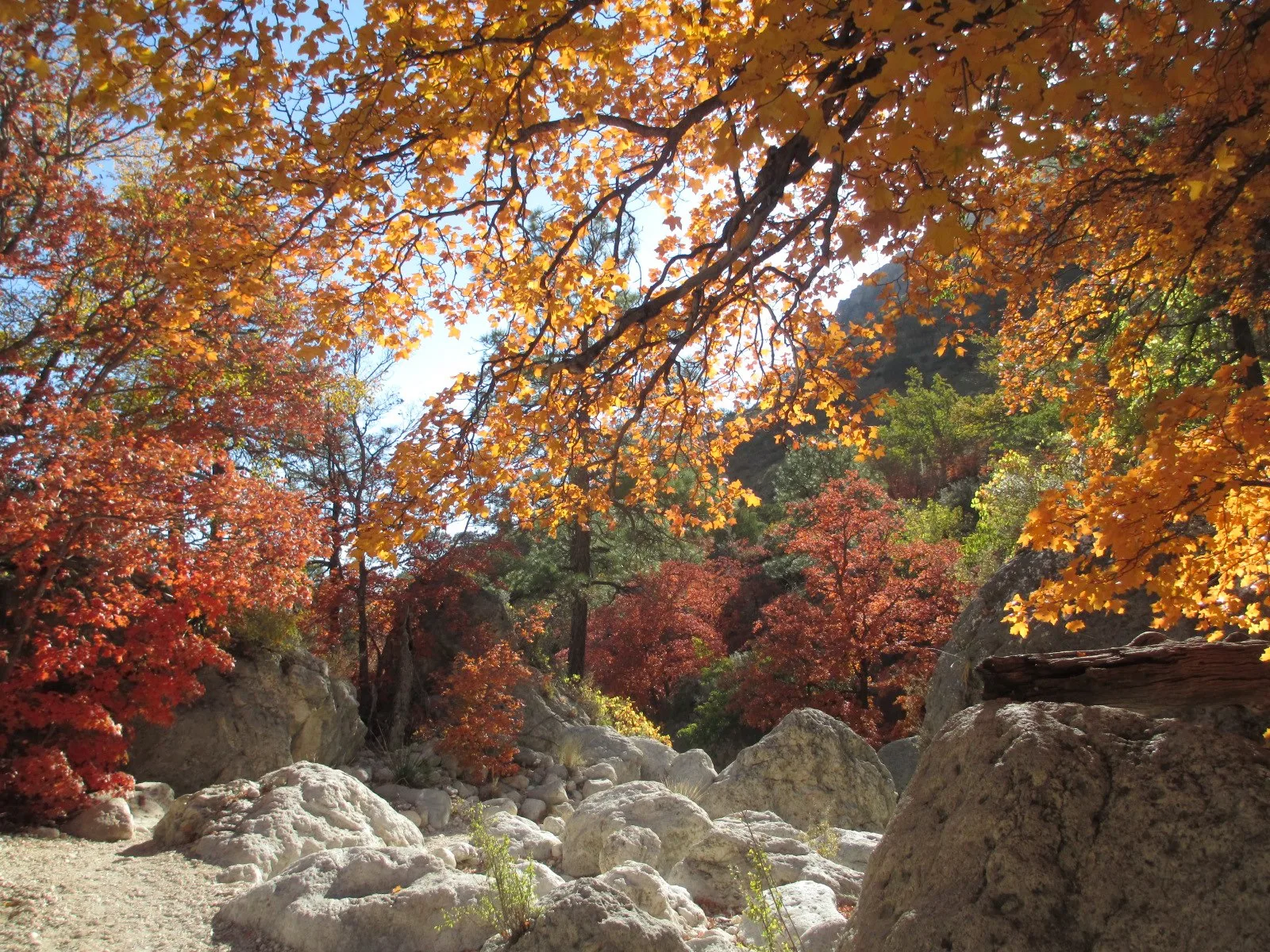
Step off the desert floor into McKittrick Canyon and the temperature drops before the scenery changes. Steep walls shade the canyon floor for most of the day, moisture collects instead of evaporating, and the result is a narrow, cool, wet pocket sitting inside one of the driest landscapes in Texas. The National Park Service's own description is blunt about how strange this is: the park's higher elevations "provide the right habitat for maples and other deciduous trees to thrive in an otherwise inhospitable desert environment." Bigtooth maples do most of the work, turning a deep red-orange each fall, joined by the red-barked, evergreen-leafed Texas madrone and stands of oak and ash further up the drainage.
The color usually peaks the last week of October into the first week of November, though the full window runs from mid-October to mid-November depending on the year. Thousands of people make the drive for it, enough that McKittrick Canyon, day-use only and gated at 5 p.m., regularly fills its limited parking on the best weekends. One old description of the place calls it simply the most beautiful spot in Texas. Nobody who wrote that was exaggerating for effect.
- Peak window LATE OCT–EARLY NOV
- Season MID-OCT THROUGH MID-NOV
- Access DAY USE ONLY · GATE CLOSES 5PM
- Trees BIGTOOTH MAPLE, TEXAS MADRONE, OAK
Time Your Visit for Peak Color
McKittrick Canyon's parking fills fast on fall weekends. Build a trip plan around it, not around a guess.
Open the Trip PlannerWallace Pratt Fell for This Canyon and Never Let Go
Wallace Pratt was, by the 1920s, one of the most consequential figures in American oil exploration, the man who helped turn petroleum geology from what one account calls a "hit or miss operation" into an actual science, first at Humble Oil and later as a vice president at Standard Oil. A business trip introduced him to the Guadalupe Mountains in 1921, and something about the country stuck with him. He and a few partners bought ranch land here, and by 1930 Pratt had bought out his partners and kept expanding his holdings on his own.
Over the winter of 1931 and 1932, Pratt had a stone cabin built two miles inside McKittrick Canyon, at the spot where its north and south forks meet. The limestone came from a quarry four and a half miles off, hauled in by truck and horse-drawn sled. A Houston architect named Vance Phenix drew the plans; his brother Dean did the carpentry; a stonemason named Adolph May laid up the walls; the yellow pine for the timber came in from East Texas by way of Carlsbad, New Mexico. It was not a quick build, and it was not a casual one. Then, in 1963, Pratt gave the whole thing away, donating more than 5,600 acres, the cabin included, to the National Park Service. That gift became the core of what, nine years later, opened as Guadalupe Mountains National Park.
- First visited canyon 1921
- Cabin built WINTER 1931–1932
- Land donated 1963 · OVER 5,600 ACRES
- Park established 1972
Fall color timing, access rules, and the canyon's microclimate explanation checked against the National Park Service's official pages on McKittrick Canyon and fall colors at Guadalupe Mountains. Wallace Pratt's career, cabin construction, and the 1963 land donation checked against the National Park Service's official page for Pratt Cabin. Pratt's broader career history checked against publicly available biographical records.
Every fall, people drive out to McKittrick Canyon to see leaves change color in a place that, by every rule of the surrounding desert, shouldn't have leaves to change at all. Almost none of them know that the reason they're allowed to walk in at all traces back to an oil geologist who saw this same canyon a hundred years ago, liked it enough to build a stone house in it by hand, and then simply gave it away. The maples would have kept turning red whether or not Pratt ever showed up. Whether the rest of us could come watch them do it was, for a while, entirely up to him.