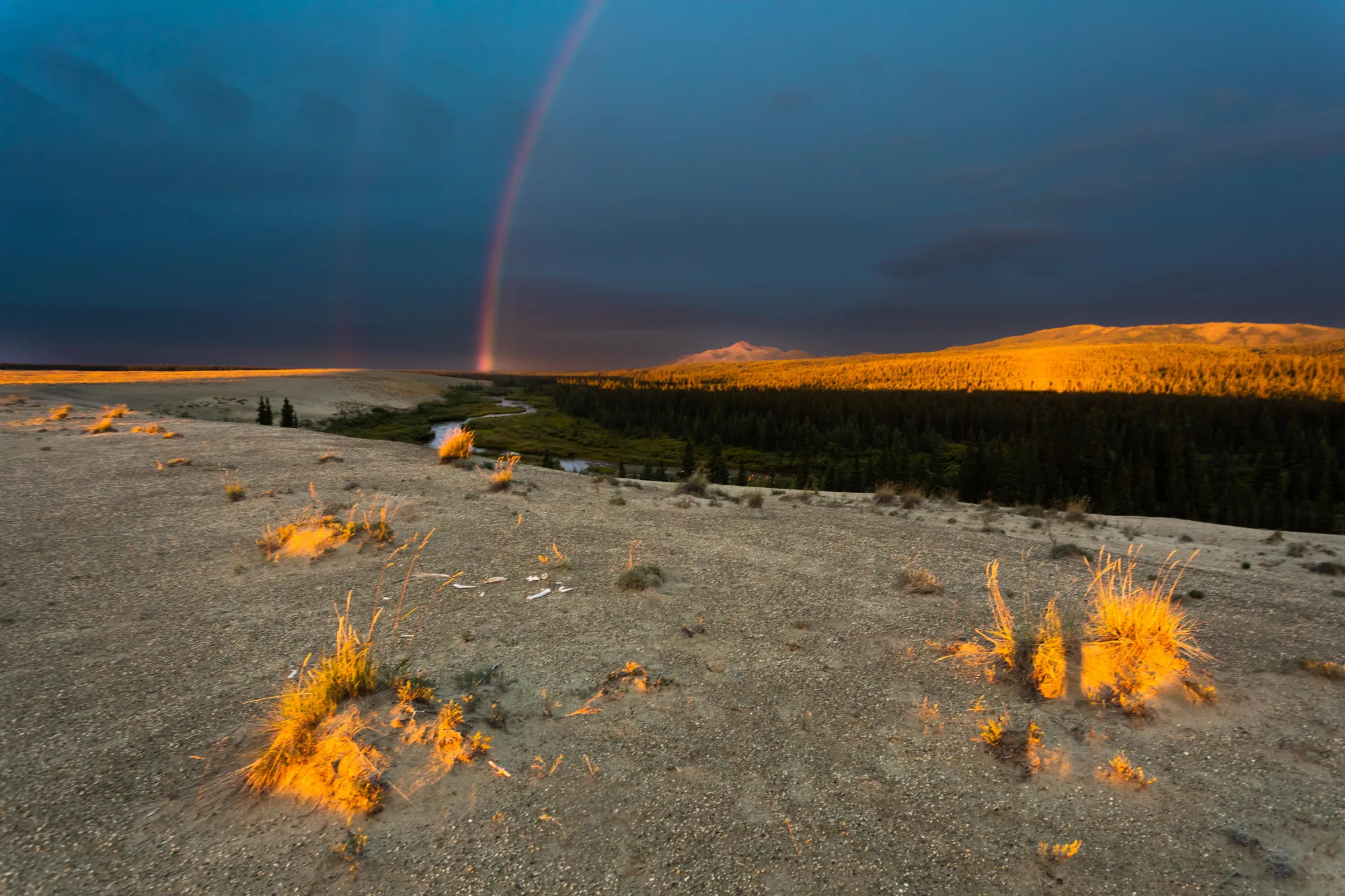
Every fall, caribou from the Western Arctic Herd cross the Kobuk River at a narrow bend the Iñupiat call Paatitaaq, and hunters have been waiting for them there for something close to ten thousand years. In 1940, an archaeologist named J. Louis Giddings noticed the same bend for a different reason: the riverbank above it was eroding, and the gullies cutting down through it were exposing something no one had documented in Arctic Alaska before.
The Engineer Who Became an Arctic Archaeologist
James Louis Giddings was born April 10, 1909, in Caldwell, Texas, and earned a bachelor's degree in engineering from the University of Alaska in 1932, working as an engineer for five years before shifting into academia in 1938. He went on to a PhD from the University of Pennsylvania in 1951 and became a professor of anthropology at Brown University in 1956, where he also directed the Haffenreffer Museum of Anthropology. What set Giddings apart was a technique he brought over from his engineering training: subarctic dendrochronology, tree-ring dating, which he was the first to apply in the Arctic, using wooden artifacts pulled from sites along the Kobuk River to build a chronology no one else had.
Over three decades of fieldwork in northwest Alaska, Giddings helped identify the Ipiutak culture at Point Hope and discovered the previously unknown Denbigh Flint complex, a Paleo-Eskimo culture that pushed the known record of human presence in the region back thousands of years. He first visited the Onion Portage site in 1940 during an early trip up the Kobuk River, and returned for a limited excavation in 1941. It wasn't until a 1961 visit that he recognized what he was actually looking at: a riverbank cut into highly stratified layers, each one a separate, datable slice of Arctic history stacked directly on top of the last.
- Born APRIL 10, 1909, CALDWELL, TEXAS
- Engineering degree UNIVERSITY OF ALASKA, 1932
- PhD UNIVERSITY OF PENNSYLVANIA, 1951
- Professor, Brown University FROM 1956
- First saw Onion Portage 1940
Plan a Kobuk Valley Trip
Onion Portage sits well upriver from the dunes, a real stop on a real river float from Kotzebue.
Open the Trip PlannerNine Cultures, Stacked in One Riverbank
Giddings led a major excavation at Onion Portage in 1964, deliberately pushing deeper than his earlier work in search of older cultural layers. What his team uncovered were nine distinct cultural complexes, stacked one atop another in strict sequence and spanning roughly 6500 BC to AD 1700, an unbroken record of the people who had used this exact river crossing across more than eight thousand years. It's one of the most completely stratified archaeological sites ever documented in the Arctic, and it remains a reference point for dating and comparing other Arctic sites to this day.
Giddings didn't live to see the excavation's full impact. He died on December 9, 1964, in Pawtucket, Rhode Island, of a heart attack while recovering from an automobile accident, the same year as his last Onion Portage dig. The cabin his team used during that 1964 season, now known as the Giddings Cabin, is the only built structure inside the Onion Portage Archeological District and has been preserved by the National Park Service. The site was added to the National Register of Historic Places in 1972 and designated a National Historic Landmark District in 1978. The crossing itself never stopped being used the way it always had been: qayaqs and spears have given way to motorboats and rifles, but the Iñupiat still hunt caribou at Onion Portage during the same fall crossing Giddings found already ancient in 1940.
- Major excavation 1964
- Cultural complexes identified NINE
- Time span ~6500 BC – AD 1700
- National Register listing 1972
- National Historic Landmark District 1978
J. Louis Giddings' biography, career, and death checked against a published Wikipedia account consistent with his professional obituary record. Onion Portage's excavation history, cultural layers, and landmark designations checked against the National Park Service's own account of the site. The continuing Iñupiat caribou hunt at Onion Portage checked against the National Park Service's history of Kobuk Valley.
The gullies that first caught Giddings' eye in 1940 are still cutting into that same riverbank today, still slowly exposing more of what's buried there. He spent his career teaching himself to read what a tree ring, or a buried hearth, or a flake of stone could say about the people who left it behind, and at Onion Portage, that record turned out to run nine layers deep and eight thousand years long, with the ninth layer, the living one, still crossing the river every fall.