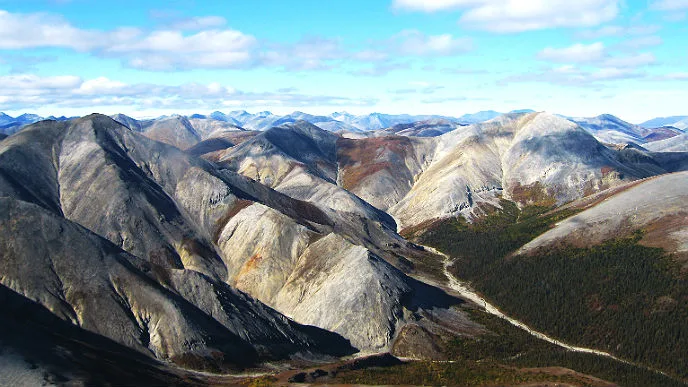
Kobuk Valley National Park has no roads, no maintained trails, and not a single permanent resident inside its boundary. It can look, from a plane window, like empty country. It isn't. Families whose grandparents and great-grandparents lived inside what's now the park still travel back into it every year, by boat, snowmachine, and dogsled, to hunt the same caribou, fish the same river, and stand on the same ground their villages once stood on.
They Moved the Village, Not the Ties
Iñupiaq villages existed within the boundaries of what's now Kobuk Valley National Park through the early twentieth century, part of a subsistence tradition in the region that stretches back more than 8,000 years. Over the course of the 1900s, families gradually resettled outside the eventual park boundary, moving to villages like Kiana along the lower Kobuk River. A years-long study built on direct collaboration between researchers and Kiana residents, titled "I Love that Country, That's Why I Go There," documented just how much that relocation didn't actually sever: families still maintain small cabins on land allotments inside the old boundary, still travel back by snowmachine and dogsled to places that carry personal and ancestral meaning, and still return each year for the hunting, fishing, and gathering that defined the place their grandparents called home.
That return isn't nostalgia, it's provisioning. Residents hunt caribou at the Kobuk River's traditional crossing points, fish the river for salmon, and gather berries in late summer to carry them through winter. Some also guide visiting hunters and fishers as part of the same seasonal round. The line on a park map changed who's allowed to live where. It didn't change where people go to eat.
- Subsistence tradition in the region 8,000+ YEARS
- Villages inside the boundary OCCUPIED INTO THE EARLY 1900s
- Relocation GRADUAL, THROUGH THE 1900s, TO VILLAGES LIKE KIANA
- Kiana study "I LOVE THAT COUNTRY, THAT'S WHY I GO THERE"
Plan a Kobuk Valley Trip
Kotzebue is the shared gateway to Kobuk Valley, and the villages along the Kobuk River are still very much lived in.
Open the Trip PlannerThe Law That Keeps the Old Round Legal
When Congress created Kobuk Valley National Park under the Alaska National Interest Lands Conservation Act, it explicitly recognized that continued subsistence use by rural Alaska residents, Native and non-Native alike, on public lands, and by Alaska Natives on Native lands, is essential to Native physical, economic, traditional, and cultural existence. That recognition isn't a footnote. It's written into how the park is actually managed: a nine-member Subsistence Resource Commission, drawn from the surrounding communities, meets twice a year in Kotzebue to advise on hunting and fishing regulations, harvest limits, seasons, and how to resolve conflicts between subsistence users and other visitors.
Communities across the surrounding NANA region hold recognized subsistence ties to the park, cultural connections the National Park Service describes as spanning countless generations: Ambler, Buckland, Deering, Kiana, Kivalina, Kobuk, Kotzebue, Noatak, Noorvik, Selawik, and Shungnak. Families from these villages still hunt caribou at the Kobuk River crossings each fall, in years when the Western Arctic Herd is near its historic size, numbers that have run into the hundreds of thousands of animals moving through in a single season. It's the same herd, the same river, and largely the same seasonal round the region's families have followed since long before there was a line on a map to cross back over.
- Legal foundation ANILCA
- Governing body 9-MEMBER SUBSISTENCE RESOURCE COMMISSION
- Meets TWICE YEARLY, IN KOTZEBUE
- Communities with recognized ties ACROSS THE NANA REGION
Subsistence history, relocation, and the Kiana study checked against the National Park Service's account of Kobuk Valley's human history and a published academic monograph on Kiana village's ties to the park. Subsistence law, the Subsistence Resource Commission, and the list of affiliated communities checked against the National Park Service's own subsistence management pages. Where a source's stated community count didn't match its own list of names, we listed the communities named rather than repeat an uncertain total.
No one will hand a visitor a village tour inside Kobuk Valley National Park, because there's no village left standing inside the line. But fly over the river in the right week of fall and the boats pulled up on the gravel bars, the smoke from a fish camp, the people waiting at the same bend Giddings once excavated, belong to families who never actually agreed to leave. They just moved the house. The country stayed exactly where it was.