
A saguaro can stand for two hundred years, and for most of that time it looks less like a plant than a piece of desert architecture, ribbed, pleated, unmistakable. What it actually is, once you know where to look, is closer to an apartment building. Woodpeckers dig the first units. The cactus, wounded, does something odd in response: it heals the hole into a hard, waterproof shell and keeps growing around it, vacancy included.
Everything that happens after that, an owl small enough to fit in your palm, doves that time their whole migration to one plant's fruiting schedule, a bat that pollinates it after dark, traces back to that first hole and the strange, durable scar it leaves behind.
The Saguaro Boot
Gila woodpeckers carve small cavities into a saguaro's flesh at mid-height, where the plant's internal ribs sit far enough apart to work around. Gilded flickers, with stronger bills, drill larger holes higher up. Either way, the saguaro responds by sealing the wound with a resinous sap that hardens over roughly a year into a rigid, bark-like lining, waterproof and distinct from the soft flesh around it. That hardened shell is called a boot, and it's tough enough that when the rest of the cactus eventually dies and rots away, the boot can still be sitting there in the sand, intact. The Seri people historically collected these as small, ready-made water containers. Collecting one today is against Arizona law, the same protections that cover the living plant.
Elf Owls, Subletting
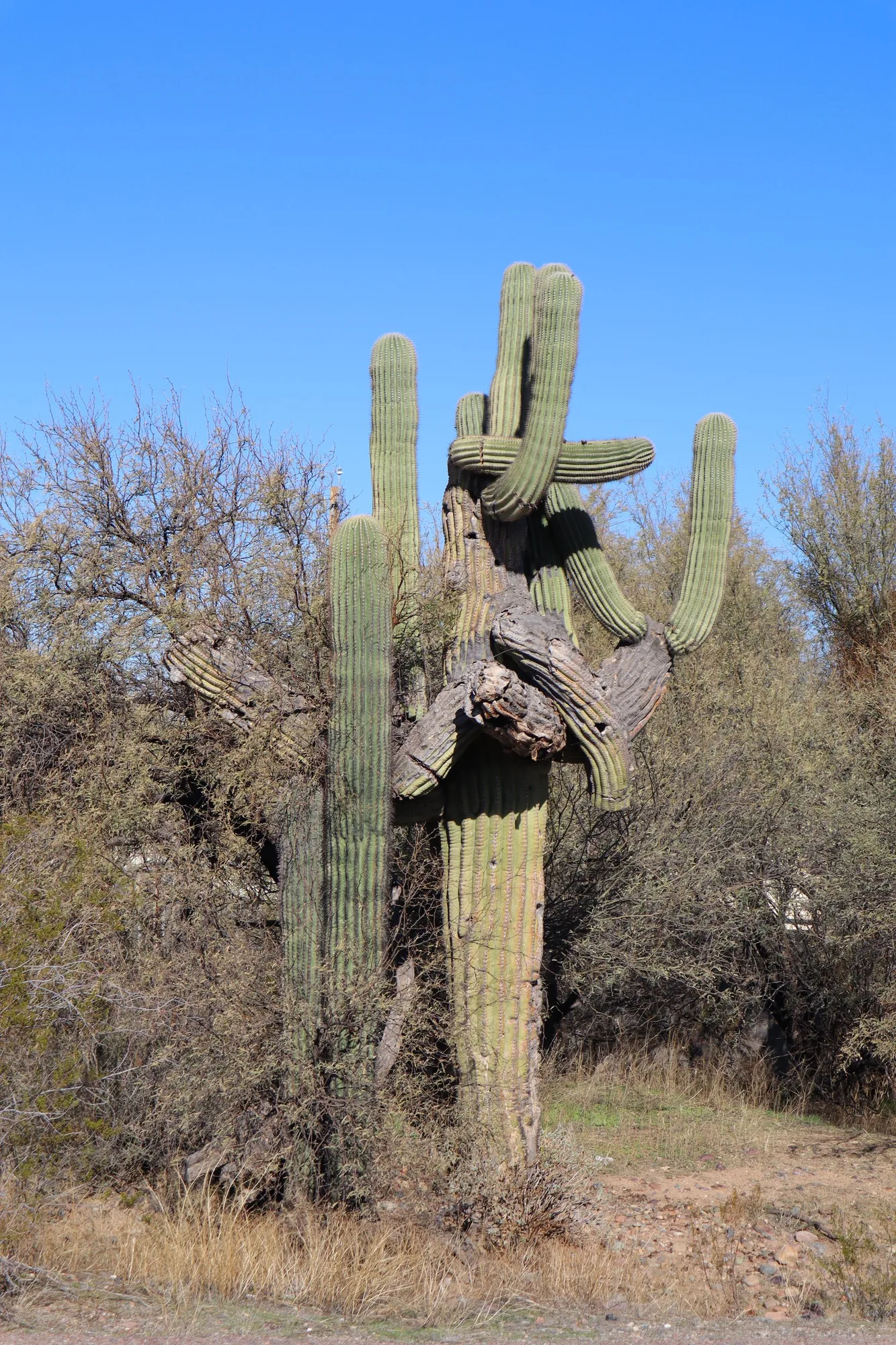
The elf owl is the smallest owl species on Earth, about five inches tall, an ounce and a half, with a nine-inch wingspan, small enough that a woodpecker's abandoned cavity fits it perfectly. It moves into former Gila woodpecker or flicker holes fifteen to thirty-five feet up, lays two to four white eggs, and hunts moths, crickets, scorpions, and centipedes entirely by sound in total darkness. When threatened, it plays dead. Elf owls are migratory, present in the park roughly March through October, and they winter in Mexico, because Arizona's winter nights don't carry enough flying insects to feed them. Western screech-owls, purple martins, kestrels, and various finches and sparrows take over other abandoned holes the same way, an entire rotating tenancy inside one plant.
- Elf owl height ~5 IN
- Elf owl weight 1-1.5 OZ
- Boot lining forms in ~1 YEAR
- Elf owls present in park MAR-OCT
Plan Your Saguaro Visit
Cavity-nesting birds are easiest to spot from the Bajada Loop and Cactus Forest Drive at dawn and dusk. The trip planner can help you time it right.
Open the Trip PlannerThe Doves That Arrive on Schedule
White-winged doves migrate into the Sonoran Desert timed almost exactly to saguaro bloom, late April into mid-June, and stay through the fruiting that follows in June and July. They arrive to breed during the hottest, driest stretch of the desert year, when saguaro nectar and fruit are among the only reliable food and water sources around. Researchers describe the western population of white-winged doves as uniquely dependent on saguaros among the species' twelve populations worldwide. The relationship cuts both ways: the doves pollinate the flowers as they feed, but they also eat the seeds afterward, making them partner and predator to the same plant in the same visit.
A Bat That Came Back From Near-Extinction
Saguaro flowers open after dark to attract the lesser long-nosed bat, which follows a migratory nectar corridor north from Mexico each spring, feeding on saguaro and organ pipe cactus blooms along the way. The species was listed as endangered in 1988, when fewer than a thousand bats remained across fourteen known roosts. Three decades of binational conservation work between U.S. and Mexican agencies, researchers, tribes, and even tequila producers, who share an interest in the same agave plants the bats also pollinate, brought the population back to roughly two hundred thousand bats across seventy-five roosts. The U.S. Fish and Wildlife Service removed it from the endangered species list on April 17, 2018, the first bat species ever delisted for having recovered.
Facts and figures checked against the National Park Service's Saguaro biology and bird pages, the Arizona-Sonora Desert Museum's elf owl and white-winged dove research summaries, and the U.S. Fish and Wildlife Service's 2018 lesser long-nosed bat delisting announcement.
Walk the Bajada Loop at dusk and the traffic in and out of any one saguaro's boots is usually happening too fast and too quietly to catch, a woodpecker's old hole, a sparrow ducking in, a moth disappearing mid-flight into something smaller than it. The cactus itself never asked for any of it. It just healed a wound the only way it knows how, and the shape that healing took turned out to be exactly the shape something else needed to survive the desert too.