Forest Loop Trail
Easy
1 miflat~30 min
An easy loop through coastal rainforest near Bartlett Cove, the park's most accessible hike. No permit.
 National
Alaska · Park 57 / 64
A bay that didn't exist 250 years ago, carved open by one of the fastest glacial retreats ever recorded.
When Captain George Vancouver charted this coastline in 1794, Glacier Bay was almost entirely filled with ice; the glacier that once occupied it has since retreated more than 65 miles, one of the fastest glacial retreats ever documented, opening up the bay that gives the park its name within just a few human lifetimes. Most visitors now experience the park from the water, aboard a cruise ship, tour boat, or their own vessel, since no road connects Glacier Bay to Alaska's highway system at all.
Margerie Glacier, at the head of Tarr Inlet, remains one of the most reliably active tidewater glaciers to watch, its face regularly shedding chunks of ice into the water in a process called calving, sometimes dramatically enough to produce waves. Bartlett Cove, near the small community of Gustavus, is the only part of the park most visitors ever set foot on, with a handful of short trails and the park's lodge and visitor center.
Come for a glacier that's still visibly retreating in real time. Stay to watch it calve, if you're lucky with timing. Read the story, book a boat or cruise well ahead, and when you leave, mark it visited.

Margerie Glacier is always the star of the show when cruising Glacier Bay, its towering white and blue ice wall framed by steep, dark mountain ridges.Adapted from visitor accounts of cruising past Margerie Glacier
Six ways to spend your time, nearly all of them from the deck of a boat watching ice meet the sea.
The park's most reliably active tidewater glacier, regularly calving chunks of ice into Tarr Inlet.
The signature experience · cruise or day boatHumpback whales are commonly seen throughout the bay during the summer season, often from the same boat as the glacier tour.
Everyone · on any boatA calmer, closer-to-shore paddling option for those not aboard a larger tour vessel.
Half day · rentals availableThe main visitor contact point near Bartlett Cove, with exhibits and current wildlife and glacier updates.
Everyone · 30 minA handful of short forest trails near the lodge, the only land-based hiking most visitors will do here.
Everyone · 1–2 hrA Tlingit clan house near Bartlett Cove honoring the Huna Tlingit people's historic and ongoing connection to the bay.
Everyone · 30 minAnswer a few questions right here. We'll map your day, stop by stop, with a route, timings, weather, and a packing checklist grounded in real park data. No account, no leaving this page.
⚡ In a hurry? Adventure Light 5 questions →This park is almost entirely water-based; the handful of trails near Bartlett Cove are rated honestly below.
An easy loop through coastal rainforest near Bartlett Cove, the park's most accessible hike. No permit.
A longer forest trail following the Bartlett River toward tidal flats, good for birding. No permit.
The primary way to see the park's tidewater glaciers, aboard a cruise ship or dedicated tour vessel into the bay.
A calmer paddling option near Bartlett Cove for those exploring independently of a larger tour boat.
A flat beach walk near Gustavus, tide-dependent, with views back toward the bay. No permit.
Extended, self-guided kayak expeditions deep into the bay's arms, requiring genuine sea kayaking and cold-water experience.
No permit for Bartlett Cove trails · free permits required for overnight backcountry kayak trips · no road connects Glacier Bay to the rest of Alaska; access is by air or water only
Tap any animal to learn its story. Soon, the app will let you log what you spot and keep a life list for every park.
Common throughout the bay during the summer feeding season, a highlight of nearly every tour boat trip.
Common throughout the park's coastal forest and shoreline, occasionally visible from tour boats near the water's edge.
Has recolonized the bay in significant numbers after being hunted nearly to extinction in past centuries.
Common resting on floating ice near tidewater glaciers, using icebergs as safe resting platforms away from predators.
Common on the steep terrain surrounding the bay, visible from boats along certain stretches of coastline.
Common throughout the park's shoreline, frequently perched in trees watching the water for fish.
Present in the park's forested areas, rarely encountered given the difficulty of land access.
One of the first trees to establish on land exposed by the retreating glacier, part of an ongoing, observable forest succession.
Often the very first plant to establish on newly exposed glacial ground, beginning the process of soil formation.
Found in the older-growth forest sections around Bartlett Cove, part of the temperate rainforest ecosystem.
Common throughout the park's open and disturbed ground, a familiar sight across much of coastal Alaska.
An early-succession shrub common on land recently exposed by glacial retreat, helping fix nitrogen into poor soil.
Found in some of the park's older coastal forest stands, tolerant of the region's wet, mild climate.
When first charted in 1794, Glacier Bay was almost entirely filled with ice; the glacier has since retreated more than 65 miles, one of the fastest retreats ever recorded.
Margerie Glacier moves forward at roughly 6 to 7 feet per day even as it continues to calve ice into the bay.
No road connects Glacier Bay National Park to the rest of Alaska's highway system; access is only by air or water.
The retreating ice has created a living laboratory for studying plant succession, from bare rock to mature forest, within a single human lifetime.
The questions people actually ask, answered from the park’s own current guidance. Fees and permit rules change every year, so each answer links back to the National Park Service page it came from.
No. Unlike most national parks, Glacier Bay doesn't charge an entrance fee. That's separate from whatever you might pay a cruise line, tour boat, lodge, or guide for their own services inside the park. Source: NPS.gov
Yes. If you're entering park waters north of Point Gustavus and Point Carolus between June 1 and August 31, a free private vessel permit is required, and the number issued each day is capped. For 2026 the park moved to a new online permitting system that requires a Login.gov account and a Glacier Bay National Park Permits account, and permitted boaters also have to attend a required annual orientation, held at 8am, noon, and 4pm at the Visitor Information Station over summer 2026. All boats must radio or call the park before entering or leaving park waters from May 1 through September 30, permit or not. Source: NPS.gov
The main visitor season runs from late May through early September, with July as the peak month for cruise ships, lodge access, and ranger programs. The park stays open year-round, but outside that window visitor services are very limited since most lodging, tours, and transportation shut down for winter. Source: NPS.gov
Most visitors see it from a cruise ship, since there's no road into the bay and the park is reachable only by water or air. Cruise ships don't dock inside the park, but they typically spend 9 to 10 hours cruising through it, and NPS rangers board to point out calving glaciers, brown bears, humpback whales, and sea otters along the way. Source: NPS.gov
Stories, guides, and hard-won tips from the trail. The full Glacier Bay deep dive lives on the blog.
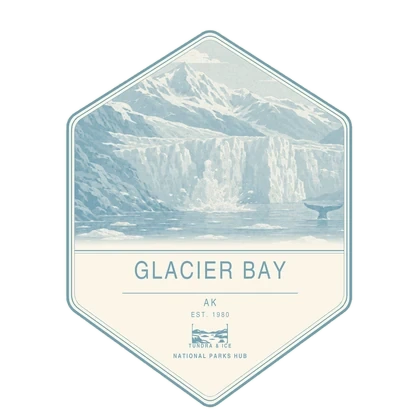
Log the visit, keep your story, and watch the map of all sixty-four fill in behind you. Every visit has a keepsake worth holding.
See the full map and track every park you have visited.
View the map → PlanTurn Glacier Bay into a trip with a custom, day-by-day itinerary.
Start planning → Go deeperDenali's 20,310-foot summit, Wrangell-St. Elias, Glacier Bay, and an active volcano: Alaska's parks by mountain range.
Read it → Go deeperIn 1794 this bay was already retreating from a wall of ice. Today the water runs sixty miles deep.
Read it →
Offline maps, your passport, and every park in your pocket on the trail.
Join the waitlist →
The printed edition, part atlas, part journal, one story per park.
Notify me →Park-guide posters, enamel stamps, and the passport book to fill in.
Visit the shop →Field Notes
The parks do not perform for anyone. They stood here before the road, and they will stand here after it.